Saturday, January 6, 2018

The end of an era

July marked the last of intense summer sampling for my PhD (and fall sampling was fairly quiet...too hot or too cold!) We found an unexpected reptile while surveying plots at night in July:
This juvenile Eastern fence lizard (Sceloporus undulatus) was just as surprised to see us, but either pretended we couldn't see him or was too sleepy to run away!

Speaking of sleepy animals, this small rabbit seemed content to let us take pictures:


We also found this cute little worm snake!

Toads always seem to be looking down on the world as if they are royalty and therefore superior to the rest of us...

This drab looking moth has striking color and spots on its hidden wings. This is likely a way to distract predators if camouflage fails. 

One of the more unusual finds of July was this ant-mimic spider. The spiders look like the ants to blend in, and more easily catch prey, an actual wolf in sheep's clothing. This type of mimicry is sometimes called Wasmannian mimicry. 


A completely different type of "mimicry" is called convergent evolution. This process results in similar morphologies (shapes or appearances) for very different organisms to deal with the same types of problems or needs. In the case below, we found some sort of longhorn beetle (I think), and I noticed that it had very large and distinctive foot pads. They reminded me of gecko feet (see images below)! These broad foot pads help both animals climb. Isn't biology amazing?!?!
Picture source: https://www.technologyreview.com/s/543506/a-strapless-bra-thats-as-sticky-as-gecko-feet/ 

No post is complete without a few pictures of my study organisms, salamanders!
Orange cheeks and legs!
Beautiful hybrid, white spots and red legs!

Plump red salamander! 

Surveying their domain....
Someone has been eating well...


Almost looks like a carrot shaving!

Fun fungi and a small orchid:


BONUS content! 
In September (2017), we found this beautiful timber rattlesnake (Crotalus horridus) waiting for unsuspecting rodents to run by! The scales looked so soft with the subtle mottling, I really wanted to touch it, but I knew that would be an extremely foolish thing to do...so I didn't. 


I will be helping with fieldwork this spring before I graduate and (hopefully) start working in another place. So stay tuned for more adventures! 

Tuesday, July 25, 2017

Splashing through the streams

We did stream sampling again this year. We didn't have time or people to do it last year, but managed to squeeze it in this time around. This sample is part of a long term study and collaboration with the Forest Service about the impact of Rhododendron removal. For the study we fill mesh pockets with leaf litter then check them for salamanders for 3 consecutive days. There are 4 streams but with 60 leaf packs per stream, we can only do two (at most) in one day. We split into teams to get all of the sampling done in one week. The two streams I worked in are reference streams and still covered in Rhododendron, which makes it difficult to move around. We ended up needing two days to set streams because of this (and being short on people). Needless to say it made for a very long week. 

But when filling the leaf packs, we managed to unearth this TINY Desmognathus ocoee salamander. It was translucent and you could see its heart beating!! <3


Along side the stream we found this very pale Spring salamander (Gyrinophilus porphyriticus):


And this extremely bright Eastern Red-spotted Newt (eft stage, Notophthalmus viridescens) They always look like they should be a toy instead of a live animal...

Next to the stream I also noticed these two small fungal growths on the tips of Rhododendron leaves.


I think they are a type of cordyceps fungus. Cordyceps fungi are parasitic and also called "zombie fungi" because they alter an organism's behavior to suit their needs. I think the two pictured above might have been ants...

In the streams we mostly find larval salamanders (a juvenile stage with external gills). Though we found a few tiny Blue Ridge Two-lined Salamander (Eurycea wilderae) larvae and a couple Spring salamander larvae, we mostly find Desmognathus larvae. We think they are mostly from Black-belly salamanders (D. quadramaculatus) but some of the adults we found don't quite look right (see pictured below). They had shorter snouts and more forward facing eyes. We think they might be Dwarf Black-belly salamanders, but would need to conduct genetic studies to be sure. 


This same week we spotted a velvet ant (which is actually a type of wasp) at the dorm. These insects are beautiful but pack a powerful sting. 
Stream sampling week was exhausting, partially from working during the day, I was happy to get back to night time work for the rest of the summer! More on that soon!

Daylight Adventuring (and a few salamanders at night)

"Everything the light touches is my kingdom"
Rain in the last couple weeks of May brought out many salamanders and got some of them onto the vegetation. One night I put my hand on a tree (to avoid sliding down the hill) and was startled by a salamander under my hand (but probably not as startled as the salamander!). On the same plot, I looked up and was face to face with one on another tree!

We had a class come visit from Highlands, NC and hiked up to Picken's Nose. This overlook is gorgeous.

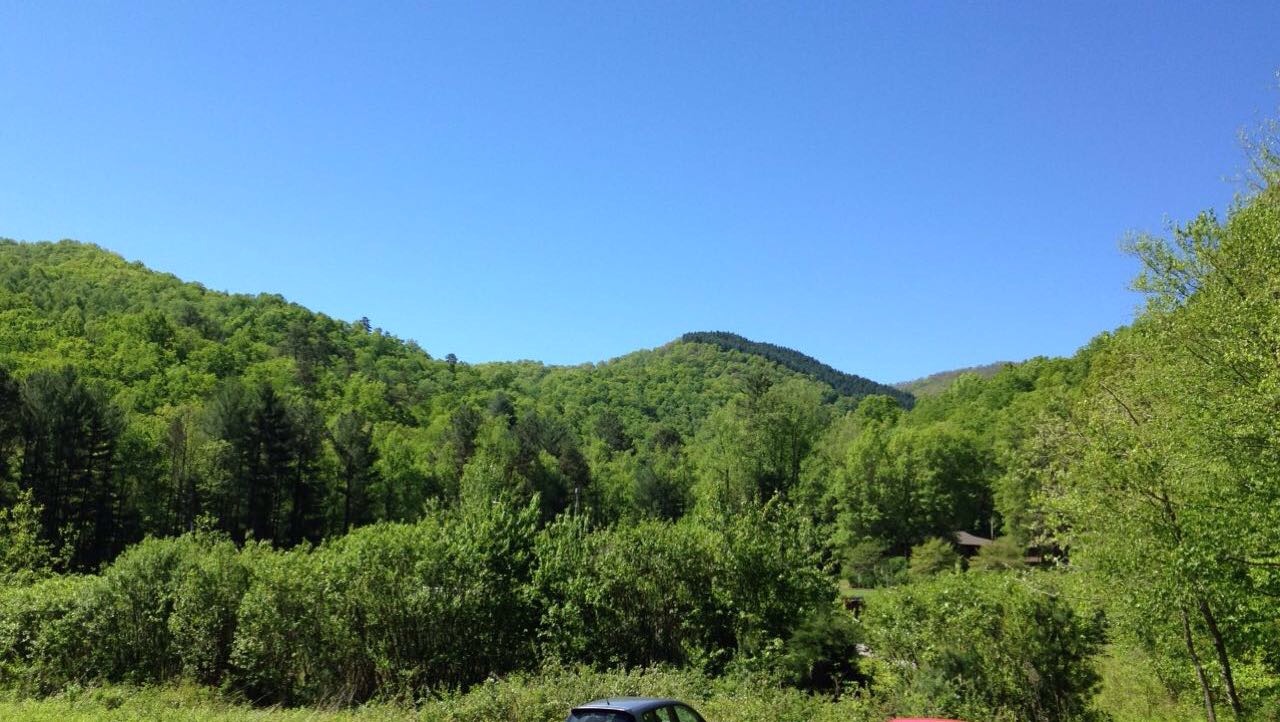
On the way, we stopped as another overlook that allows us to see the basin where I work:


One rainy afternoon I took a walk up the road and found a box turtle! This little beauty is the third one I've ever seen! He was fairly shy (which is probably good for his survival...).

On this walk I also found the tiniest inchworm!!

We found a large Black Rat Snake behind the dorm:


After these photos it proceeded to disappear between the siding and the building...

One night we found this beautiful Grey Treefrog on the road!! They have incredible camouflage and can be nearly impossible to see on tree bark, but when startled they flash bright yellow on their legs to district potential predators!


And no blog post by me would be complete with out a couple pictures of salamanders:
Fancy gold on this Plethodon's face
Seal Salamander regrowing a foot! 

To give you an idea of the steepness of our study sites: (also shout out to my beautiful models Kaitlyn and Madaline. Kaitlyn insisted this photo would be how she meets her soul mate....  :D)

That's all for now! More soon! 

Tuesday, July 4, 2017

Back to the Mountains

The beginning of May marked the start of another field season (ok, we actually started in mid-April but only for one night, so it doesn't really count...). On our way to the study sites we had to stop a couple of times to clear downed trees. Thankfully we had a saw in the back of the vehicle, because both trees were very tall and impossible to move without cutting apart first.


While driving up the main road, we unintentionally saved a salamander! From time to time we see small mammals run across the road, and I thought I saw one in the middle of the road but it was moving in a strange way. So we stopped the car to see what what happening. Instead of a small, furry creature, we found a small slimy one. A salamander was moving off the road with bite taken out of it's tail:
  At first, we thought this is what we had see from the car, but upon further exploration, I found a squished shrew (not pictured). It was slightly upsetting to know we had hit the shrew, but in the process we seemed to have saved the salamander (shrews are known predators). Talk about an odd start to the field season!. 

Late spring is a good time to see some wildflowers, though the flowering season is not in full bloom. 

Mayapple flowers (Podophyllum peltatum)


Flame azalea, just starting to bloom
Trillium! 
Bear corn (Conopholis americana)

Lady's slipper orchid (Cypripedium acaule)


Lady's slipper with a flower bud!
Some fun lichen that looks like Venus Flytraps! 
We saw a few salamanders, but not very many. The species we work with are generally more active in the summer and fall.
  

We could see incredible numbers of stars in the clear skies (one of the benefits of less rain) and it made for pretty days at the dorms between samples!
The darker green patch is a planted pine stand, as part of large scale research at the Coweeta Hydrologic Laboratory

The next week we continued sampling at different plots and found some cool invertebrates!
 <- This is a Glassy Grapeskin snail, a native to Southern Appalachia. I don't know what is different about this year, but they seem to be all over the place, and I don't remember ever seeing them before!


This is Megarhyssa macrurus (Giant ichneumon wasp). -->
It was one of the stranger insects I have seen in the woods, thankfully it didn't sting anyone or seem to care that we were there.
 <- Pretty moth, not sure what species...

We also found a worm snake (Carphophis amoenus amoenus)! 


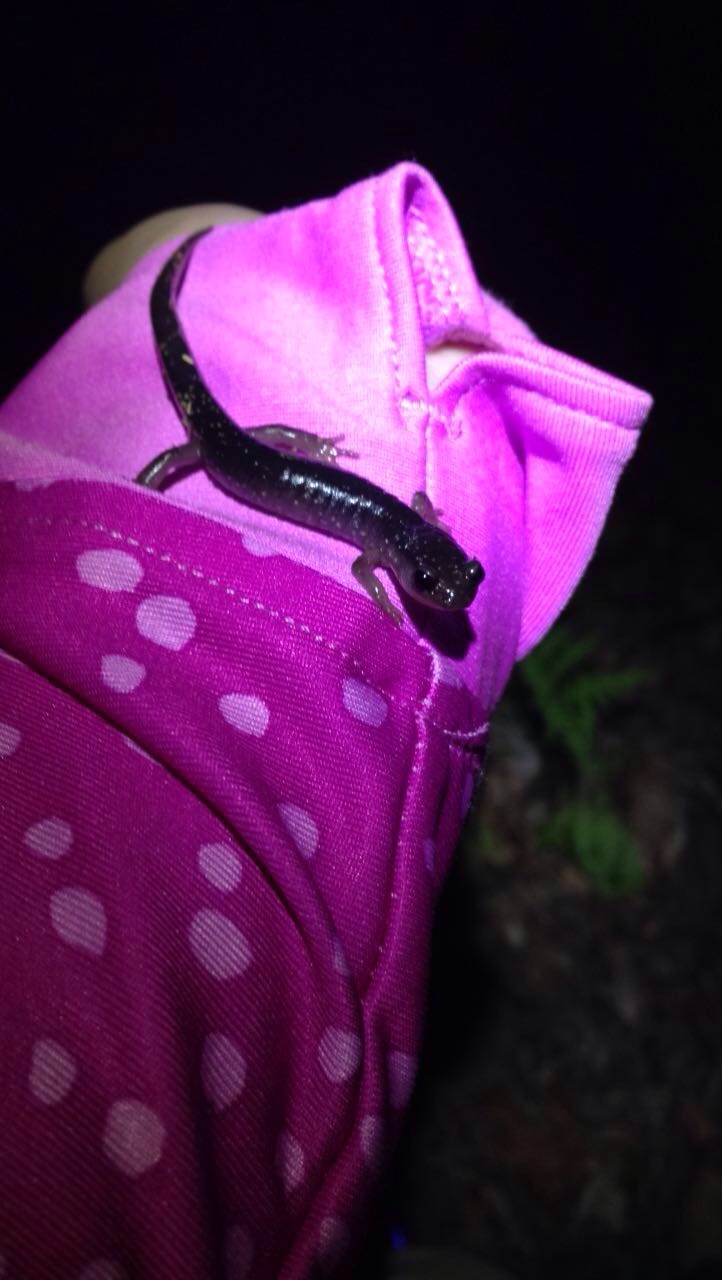
Ended the first couple weeks back getting bitten by a small salamander. It was adorable! It seemed so angry!